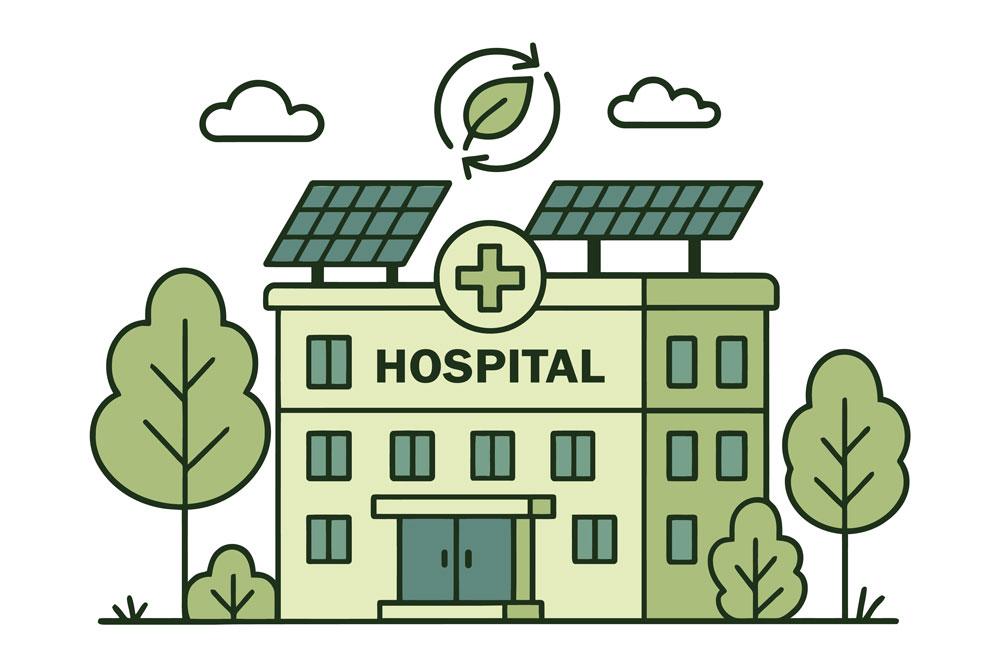


In a move to bring the NHS closer to its net zero carbon pledge in 2040, NHS Property Services (NHSPS) has launched its new Green Plan for 2025-28, which follows on from the previous Green Plan, released in 2022. This new Green Plan takes over from where its predecessor left off, and focuses on four areas: Energy, Utilities and Data, Environment, and Waste
The first Green Plan had a broader approach, setting targets across eight areas, from transport to workforce, in order to establish a holistic foundation for further change to come from. A more refined approach from the newer Green Plan will allow for greater impact on key areas by focusing time and resources on fewer, more specific goals.
Net zero by 2040
In 2020, the NHS was the world’s first health system to set a zero emissions target, as set out in the Delivering a ‘Net Zero’ National Health Service report. The pledge was embedded into legislation through the Health and Care Act 2022, and in 2021, NHS England asked trusts and systems to develop green plans spanning over three years, encouraging groups to set ambitious targets to deliver tangible results.
Emissions for the NHS estate are responsible for more than 60 per cent of the NHS carbon footprint, and NHSPS responsible for ten per cent of the estate – a sizeable chunk. Decarbonising strategies, here, then have a large potential for significant impact, that NHSPS sets out in their targeted approach.
NHSPS Green Plan 2022-25
NHSPS’ Green Plan 2022/23-24/25, while not the first move from NHSPS to reduce its carbon footprint, set broad and ambitious targets across eight areas: workforce and leadership, sustainable models of care, digital transformation, travel and transport, estates and facilities, supply chain and procurement, adaption and biodiversity, and responsible landlord. As its focus was on setting a strong precedent for deeper, target-led performance to come, the plan did not set out any key performance indicators or specific numerical targets.
That said, the previous plan saw a 48 per cent reduction in carbon emissions since a 2017-18 baseline, with savings in energy and utilities racking up to £47.8 million. The NHSPS Energy and Environment team completed over 950 sustainability related projects such as LED lighting upgrades and Solar PV, as well as publishing two years of Climate Financial Disclosures Reports. This is significant progress, but the next Green Plan brings in much-needed targets and direction for the next stage of decarbonising the estate.
NHSPS Green Plan 2025-28
Alongside reducing carbon emissions by five per cent a year, the new Green Plan sets out a roadmap from 2025-2028 across four key areas: Energy, Environment, Utilities and Data, and Waste, each one having a goal, targets on the way to meet that, and an envisioned roadmap.
Energy
NHSPS aims to achieve net zero carbon by 2040, with key performance indicators of this goal being to complete 90 decarbonisation projects over the next three years. NHSPS explains that they will reach this target through implementing a Net Zero Carbon Strategy to guide decarbonisation projects and focusing on the 100 buildings with the biggest emissions, which will create the most impact. NHSPS has also committed to funding projects like supporting zero emissions transport, installing LEDs, and Building Management Services, alongside training staff in low carbon technologies.
Environment
NHSPS has committed to continuously improving its environmental impact and meeting compliance obligations by auditing 132 of its higher risk sites to meet compliance by embedding processes, improving climate resilience, and increasing biodiversity. Alongside this, the organisation has also committed to developing sustainable travel and buying strategies while monitoring Scope 3 (third party) emissions.
Utilities and Data
NHSPS intends to help its staff and customers to use data in order to reduce utilities costs, carbon emissions and environment impact through setting targets and doubling the amount of data its customers can access. As part of this, NHSPS will introduce improvements in calculating its carbon footprint, technology for data sharing with customers, and will provide analysis and reports to stakeholders to influence their environmental impact.
Waste
NHSPS has set very ambitious and specific targets for its waste management strategy to put it in line with NHS England’s goals: 20 per cent incineration, 20 per cent infectious waste, and 60 per cent offensive waste. This will happen alongside halving carbon emissions produced from waste management by 2026. NHSPS will support this target by collaborating with staff and customers to ensure correct waste management practices are upheld by introducing the appropriate waste bags, bins, labels and posters to help customers effectively segregate their waste. By increasing waste segregation, NHSPS intends to reduce costs and lower carbon emissions.
What can customers do to help?
Decarbonising must be taken up by whole swathes of people, from head office to customers, for it to be its most effective, and NHSPS, as part of their Green Plan 2025-26, has factored this into its approach. Patients have just as much of a role in delivering a net zero NHS as those designing the plan.
The new Green Plan advises customers to speak with their Estates Coordinator to share their views on the new Green Plan, ask for clarification on elements they aren’t sure with, and consider the ways they can get involved. Additionally, NHSPS is happy to hear about other Green Plans so that both organisations will be able to work together to achieve common sustainability goals.
Change, urges NHSPS, can be implemented immediately, through making small, simple actions, like following an end-of-day shutdown plan or adding a timer to heating.
NHSPS has published top tips for others to reduce the environmental impact of their buildings through methods to save energy, from simple measures like keeping doors closed when heating or cooling is on and unplugging unused phone and laptop chargers, to more system-wide changes like reducing electricity usage when its most expensive, from 4pm to 7pm.
Other ideas include reducing single-use plastic by bringing your own reusable cutlery to work, using the short flush on the toilet when possible, and reporting environmental incidents to the Customer Service Centre as soon as possible. Alone, these changes seem small and minute, but when repeated over and over and implemented alongside other changes, these can quickly snowball into huge energy bill savings and decreased carbon emissions.
Merseyside Health Centre cuts energy usage by almost a fifth
An example of one small change making a huge difference is Merseyside Health Centre’s changes to its heating system. Previously, the system had limited controls and was switched on throughout winter, even when the centre was closed, which meant a lot of energy was wasted.
Subsequently, NHSPS’ Energy and Environment team installed a programmable thermostat, at a cost of £200 to be able to set the heating times and temperatures in line with when the building was in use.
This change, albeit simple, had monumental effects, reducing energy usage by 19 per cent. This equates to 3569kg of CO2 being saved annually at £1945, and only took two and a half month’s use to get the return on investment.
On this change, Ben Dobble, practice manager deputy at Merseyside Health Centre, said: “The thermostat installation has significantly improved temperature regulation, creating a more consistent and comfortable environment. The back-office spaces have adapted well to the new settings, with staff reporting a satisfactory temperature. Overall, the new system has enhanced our ability to maintain a comfortable working environment.”